
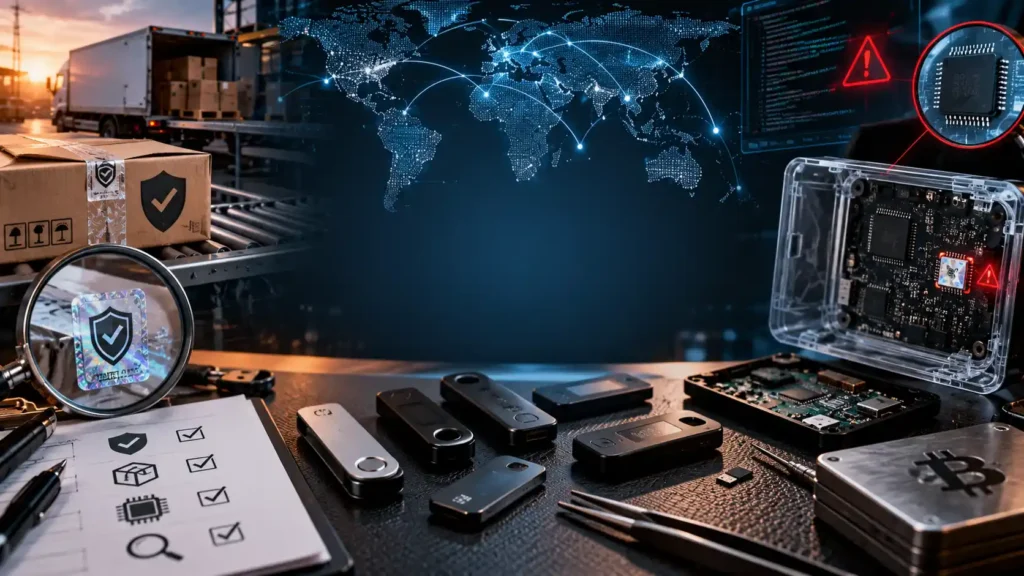
Hardware Wallet Security in 2026: Beyond the Secure Element
Why Hardware Wallet Security Must Go Beyond the Secure Element
Why crypto hardware wallet security depends on the entire device lifecycle, from manufacturing and distribution to recovery and transaction authorization.
By John Ajiboye | ASK JOFA
A hardware wallet can use a secure element, verify signed firmware and connect to an official companion application without those features alone proving that the complete physical device is trustworthy.
That distinction is fundamental to cryptocurrency security.
Hardware wallets are designed to protect the private keys that authorize transactions involving digital assets. But their security depends on more than the chip responsible for protecting those keys. It also depends on the device’s architecture, manufacturing process, physical components, distribution history, initialization procedure and transaction approval mechanism.
A weakness at one of these boundaries can undermine assumptions users make about the security of the complete device.
The central question is therefore not simply whether a hardware wallet has strong security features.
It is whether the device’s security can be meaningfully verified across its entire lifecycle.
The October 2026 Ledger hardware implant incident brings this question into focus. More importantly, it offers an opportunity to examine a broader issue affecting cryptocurrency self-custody: the difference between trusting a manufacturer’s security claims and understanding the evidence that supports them.
This article introduces the ASK JOFA Hardware Wallet Trust Lifecycle Framework, a proposed approach to evaluating hardware wallet security through architecture, manufacturing, distribution, recovery, transaction authorization and independent assurance.
What Is Hardware Wallet Security?
Hardware wallet security is the combination of hardware, software, operational controls and user procedures designed to protect cryptographic keys and ensure that cryptocurrency transactions are authorized as intended.
A hardware wallet typically aims to keep sensitive key operations within a protected environment while allowing the user to review and approve transactions.
However, the exact architecture varies between manufacturers and models. Some devices use secure elements, while others employ different combinations of microcontrollers, protected execution environments, firmware controls and communication interfaces.
A meaningful security assessment must examine how the individual components work together rather than assuming that one specification determines the security of the entire product.
Four questions provide a useful starting point:
- Key protection: How are private keys generated, stored and used?
- Device integrity: What evidence establishes that the physical device and its software match the intended configuration?
- Transaction authorization: How does the device help the user verify what they are signing?
- Recovery protection: How are recovery phrases generated, displayed, backed up and restored?
These questions are connected, but they are not interchangeable. A device may protect keys effectively while having limitations in another part of its security model.
1. The October 2026 Hardware Wallet Incident: What It Reveals
In October 2026, cryptocurrency thefts were reported involving hardware wallets purchased through the Southeast Asian reseller CryptoBilis.
In its October 15 public response, Ledger stated that its investigation had identified unauthorized hardware components installed in genuine devices. According to the company, attackers purchased legitimate devices, opened them, installed hidden components designed to capture recovery phrases during setup, and returned the modified devices to distribution.
Ledger said its chip, operating system and servers had not been compromised and characterized the incident as an attack on the distribution channel after devices had left its control.
These are the company’s stated findings and characterization, not an independent conclusion that every aspect of the incident has been definitively established.
Blockchain analytics firm Bitquery subsequently estimated that approximately $102 million had been drained from 335 wallets across six blockchain networks, based on its investigation updated on October 16, 2026. That figure is an on-chain investigation estimate, not a final loss total independently confirmed by Ledger.
Sources: Ledger’s response to the hardware implant attack and Bitquery’s investigation of the Ledger–CryptoBilis incident.
The significance of this case extends beyond the identity of the manufacturer or reseller involved.
It demonstrates why the security of a device cannot be assessed solely through its brand, advertised specifications or software verification results.
If unauthorized physical components are introduced into a device, those components may create a security risk outside the protections that users assume are covering the complete product.
The broader lesson is not that all hardware wallets are compromised or that a particular brand should automatically be considered unsafe.
The lesson is that hardware integrity, software integrity and cryptographic authenticity are different security properties.
Each requires evidence appropriate to the claim being made.
2. Why a Secure Element Does Not Guarantee Complete Device Security
A secure element is a specialized security component designed to support protected storage and cryptographic operations. Depending on its implementation, it can help protect sensitive information against certain forms of physical and logical attack.
It can be an important part of a hardware wallet’s security architecture.
But a secure element is not the entire hardware wallet.
A complete device may contain a main microcontroller, display, buttons or touchscreen, circuit-board connections, firmware, communication interfaces and a companion application. The exact arrangement varies by product.
The security question is how these components interact and where sensitive information can become accessible.
The difference between protecting a key and protecting the entire system
A secure element may be designed to prevent private-key extraction. That does not automatically establish that every other component is authentic, unmodified or free from vulnerabilities.
For example, a recovery phrase must become available to the user during wallet initialization. A transaction must also be presented for review before the user authorizes it.
These operations create security-sensitive boundaries between protected information, device components and human interaction.
If an attacker can compromise a relevant component or process at one of those boundaries, the protection provided by another component may not be sufficient to prevent the attack.
This does not mean secure elements are ineffective. It means their protection must be understood within the scope of their actual design.
The trusted display is part of the security model
The device display is not merely a convenience feature. It can be a critical part of the user’s security boundary.
Users rely on it to review recovery information during initialization and, where supported, to verify transaction details before approving them.
A meaningful hardware wallet evaluation should therefore ask:
- Which sensitive information is presented through the display?
- Which components handle that information before it reaches the user?
- How does the design protect those components and connections?
- What information can the user independently verify on the device?
- What limitations apply to the information shown for complex transactions?
The important principle is that protecting a secret requires more than protecting the place where it is stored. The complete path through which that secret is handled must also be considered.
3. Hardware Wallet Authenticity vs. Integrity vs. Security
One of the most important distinctions in hardware wallet security is the difference between provenance, authenticity, integrity and security.
These terms describe different properties. Treating them as synonyms creates a false sense of assurance.
What is hardware wallet provenance?
Provenance concerns the origin and history of a device.
It includes questions about who manufactured it, which organizations handled it, where it was stored and how it reached the customer.
Purchase records, distributor records and documented custody processes can contribute to provenance. However, a record of where a device came from does not automatically establish that it remained unchanged throughout its journey.
What does hardware wallet authenticity mean?
Authenticity concerns whether a device or component is genuine.
A manufacturer’s verification mechanism may help establish that a device contains a recognized component or satisfies particular identity checks.
But a genuine device may still be modified after manufacturing. Authenticity and physical integrity are related, but they are not identical.
What is hardware wallet integrity?
Integrity concerns whether the device’s relevant components and software remain in an expected, authorized state.
Firmware signatures, authenticated updates and suitable component-verification mechanisms can help establish aspects of integrity. Their value depends on what they verify and which assumptions the verification process makes.
A successful firmware check, for example, should not automatically be interpreted as proof that every physical component is original.
What does hardware wallet security mean?
Security is the broader question of whether the device and its associated processes protect against relevant threats.
It involves the architecture, implementation, interfaces, operating procedures and the evidence available to support the device’s security claims.
A genuine device can have vulnerabilities. A device with correctly signed firmware can still have physical-integrity limitations. A device with strong technical protections can still be compromised if a user exposes their recovery phrase.
The distinction is simple:
Provenance describes origin and history. Authenticity concerns whether something is genuine. Integrity concerns whether it remains in an expected state. Security concerns how effectively the complete system resists relevant threats.
The National Institute of Standards and Technology (NIST) addresses related issues in its publication, SP 1800-34: Validating the Integrity of Computing Devices. The guidance examines how organizations can establish component authenticity and detect unauthorized changes across device supply chains and operational use.
Although the publication is not a hardware-wallet certification standard, its supply-chain integrity principles are relevant to the broader problem of establishing trust in computing devices.
4. How a Hardware Wallet Supply Chain Can Become a Security Risk
A hardware wallet may pass through several stages before reaching its owner:
- Component sourcing and manufacturing.
- Device assembly and provisioning.
- Packaging and storage.
- Distribution and transportation.
- Retail handling and delivery.
- Initialization by the customer.
- Ongoing use, maintenance and recovery.
Each stage presents different security considerations.
Manufacturers can implement strong controls within their facilities while still needing to account for risks arising after devices leave their direct custody.
This does not mean every distributor or reseller is untrustworthy. It means that security assurance must account for the actual journey of the device rather than assuming that a reputable manufacturer automatically guarantees every subsequent handling stage.
Buying through a manufacturer’s official store or an authorized reseller can reduce certain risks associated with unknown sellers and counterfeit products.
It remains sensible advice for consumers.
However, a seller’s authorization status does not, by itself, prove that every individual device has remained physically unmodified.
Similarly, a shipping label does not establish that a parcel was physically handed to a courier, and an intact-looking package does not establish that every internal component is original.
These are different pieces of evidence.
What manufacturers should be able to explain
A serious hardware wallet manufacturer should be prepared to explain its approach to:
- Component sourcing and production controls.
- Device identity and provisioning.
- Protection against unauthorized physical modification.
- Handling of returned, repaired or refurbished products.
- Distribution and custody procedures.
- Detection and investigation of suspicious devices.
- Communication with customers when device integrity is uncertain.
The objective is not to publish every sensitive internal procedure. It is to provide meaningful assurance about the security objectives, scope and limitations of the controls that protect customers.
NIST’s supply-chain assurance guidance offers useful background on the wider challenge of verifying component authenticity and device integrity throughout a product’s lifecycle.
5. Why Hardware Wallet Authenticity Checks Have Limits
Users should follow the manufacturer’s official security guidance, obtain devices through trusted channels and use the available authenticity and firmware verification mechanisms.
These are valuable safeguards.
The mistake is assuming that any single check proves the complete device is secure.
Packaging and tamper-evident seals
Packaging can provide evidence about handling, depending on how it is designed and implemented.
But a seal cannot guarantee that every internal component is original or that no modification has occurred. Its value depends on the threat being considered and the properties of the packaging itself.
Serial-number and authenticity verification
A serial number or manufacturer verification process can help establish that a device is recognized by the manufacturer.
Users should understand what the particular mechanism actually checks. Recognition of a genuine component is not necessarily proof of the integrity of every other part of the device.
Firmware signatures and software verification
Firmware verification can help establish that software satisfies the device’s cryptographic verification requirements.
It does not automatically establish the physical integrity of every component, connection or peripheral.
The correct interpretation is that firmware verification provides evidence about firmware integrity within the scope of the verification mechanism.
Buying directly from the manufacturer
Direct purchasing can reduce exposure to certain risks associated with additional distribution, resale and return-handling stages.
It does not eliminate every possible risk associated with manufacturing, provisioning, delivery, initialization or user behavior.
The practical verification test
For every security check, users and reviewers should ask:
- What exactly does this check establish?
- What does it leave unverified?
- What additional evidence would help address the remaining uncertainty?
A verification result should be interpreted according to its actual scope, not expanded into a broader security claim.
6. Air-Gapped Hardware Wallets: What Offline Operation Does and Does Not Prove
An air-gapped hardware wallet is designed to operate without a direct electronic connection to an internet-connected computer or network during relevant operations. Some devices use QR codes or other transfer methods to exchange transaction information.
This design can reduce exposure to certain communication-based attacks.
However, air-gapping is a communication-security property. It is not a universal guarantee of physical device integrity.
Can an air-gapped wallet be compromised?
A device that lacks ordinary USB, Bluetooth or Wi-Fi connectivity may still be vulnerable to other risks, depending on its design and the threat involved.
If unauthorized hardware were introduced into an offline device, that hardware could potentially create a communication path independent of the device’s intended connectivity.
This is a general threat-model consideration, not a claim that every air-gapped wallet contains such a weakness.
What should an air-gapped wallet evaluation examine?
A serious evaluation should distinguish between:
- Which communication paths the device intentionally permits.
- How transaction data enters and leaves the device.
- What information is verified before signing.
- Which protections prevent unauthorized data transfer.
- What evidence supports the physical integrity of the device.
- Which risks remain outside the scope of the offline design.
Offline operation is a useful security property, but it should not be mistaken for proof that a device is physically uncompromised.
7. Recovery Phrase Security: The Risk Extends Beyond the Device
A recovery phrase is one of the most sensitive elements of a typical self-custody wallet.
Depending on the wallet’s design, the phrase can be used to reconstruct the keys needed to restore access to the associated cryptocurrency accounts.
Anyone who obtains a usable copy may be able to compromise the wallet without possessing the original hardware device.
That makes recovery phrase security central to any assessment of hardware wallet security.
How should a recovery phrase be protected?
Users should follow the wallet manufacturer’s official setup and recovery guidance. In general:
- Generate recovery material through the wallet’s intended initialization process.
- Never enter a recovery phrase into an unfamiliar website or unsolicited support form.
- Avoid photographing or storing the phrase in cloud notes, email or other internet-connected services.
- Keep physical backups protected against theft, loss, unauthorized copying and damage.
- Never disclose the phrase to someone claiming to be a manufacturer’s support representative.
- Understand the additional responsibilities and recovery risks associated with an optional passphrase.
The exact procedures depend on the device and wallet architecture.
What if a recovery phrase may have been compromised?
Moving a compromised recovery phrase to another hardware wallet does not make the phrase secret again.
Where compromise is suspected, users generally need to establish a new wallet using newly generated recovery material and move affected assets to addresses controlled by the new keys. The appropriate procedure depends on the wallet and assets involved, and users should follow trusted, incident-specific guidance.
They should take particular care not to expose the replacement recovery phrase during the process.
This illustrates a central principle: hardware wallet security depends on the complete process through which cryptographic secrets are created, displayed, stored, used and recovered.
8. Transaction Authorization: Protecting Keys Is Not Enough
A hardware wallet can protect private keys while a user is still deceived into approving an unintended transaction.
The transaction authorization process is therefore a separate security boundary.
Users should review transaction details on the hardware wallet’s own trusted display, where the device supports that verification, rather than relying exclusively on information displayed by a companion application.
The exact information available depends on the device and transaction type.
A straightforward transfer may be easier to inspect than a complex smart-contract interaction, token approval or unfamiliar message signature.
A hardware wallet evaluation should ask:
- Which transaction details appear on the device itself?
- Can users distinguish a transaction from a message-signing request?
- How are unfamiliar or partially decoded transactions presented?
- What warnings appear when transaction information cannot be fully interpreted?
- Which actions require explicit physical confirmation?
- What limitations should users understand before signing?
The aim is not to suggest that every device supports the same features. It is to examine whether each product helps users understand the action they are authorizing.
A hardware wallet’s security should be assessed in terms of both key protection and the process through which those keys are permitted to authorize transactions.
Multisignature arrangements can reduce dependence on a single key or signing device. For example, a 2-of-3 arrangement generally requires two authorized signers to approve a transaction.
But the number of signers alone does not establish how independent their security is.
If multiple signing devices share a common point of failure, such as a compromised distribution channel, common administrative access or poorly separated recovery procedures, the arrangement may offer less independence than its configuration suggests.
Does using different hardware wallet brands improve security?
Vendor diversity can help reduce certain correlated risks, but it is not a guarantee.
An institution should also consider:
- How each signer was sourced and provisioned.
- Whether devices are held under separate custody arrangements.
- Whether recovery material is independently protected.
- Whether administrative privileges are appropriately separated.
- Whether the signers rely on common software, infrastructure or operational procedures.
- How the organization responds if one signer is suspected of compromise.
A robust multisignature arrangement combines cryptographic separation with meaningful operational independence.
For institutional treasuries and high-value self-custody users, this is an important extension of hardware wallet security: multiple devices provide meaningful resilience only when the relevant failure modes are understood and appropriately separated.
10. The ASK JOFA Hardware Wallet Trust Lifecycle Framework
To make hardware wallet evaluation more consistent, I propose the ASK JOFA Hardware Wallet Trust Lifecycle Framework.
This is an editorial evaluation framework designed to organize research, education and future hands-on assessments. It is not an industry-approved standard, a formal certification or proof that any particular device is secure.
Its central principle is that trust must be evaluated at each critical stage of a device’s lifecycle. Evidence about one stage should not automatically be treated as proof about all the others.
Stage 1: Design and architecture
Question: What security boundaries does the device establish?
Examine the documented architecture, key generation and storage model, trusted display, communication interfaces, firmware-update mechanism and recovery design.
Identify the assumptions the device makes about its components and external software.
Stage 2: Manufacturing and provisioning
Question: How is the intended state of the device established?
Investigate the manufacturer’s published approach to component sourcing, manufacturing controls, provisioning, device identity and firmware integrity.
Where technical documentation or independent evidence is available, assess what it establishes and what remains unknown.
Stage 3: Distribution and custody
Question: What assurance exists between production and delivery?
Examine the distribution model, available authenticity mechanisms, handling of returned devices and guidance for identifying suspicious products.
Consider what evidence is available to support claims about custody and the detection of unauthorized changes.
Stage 4: Initialization and recovery
Question: How are the wallet’s secrets created and protected?
Assess the setup process, recovery phrase generation, backup guidance and restoration procedure.
Determine whether the user can complete the process without unnecessarily exposing recovery material to an internet-connected environment.
Question: How does the device help users authorize the intended action?
Examine the information displayed before signing, confirmation requirements, message-signing behavior and the handling of unfamiliar or partially decoded transactions.
Stage 6: Independent assurance and incident response
Question: What evidence exists beyond the manufacturer’s marketing claims?
Look for independent security assessments, vulnerability disclosures, reproducible technical evidence where applicable, documented limitations and credible incident-response procedures.
Distinguish manufacturer statements from independent findings and from tests a reviewer has personally completed.
How the framework should be used
The framework is intended to make security claims easier to examine and compare.
Some properties may be tested directly. Others may be supported by documentation, independent assessment or manufacturer disclosures. Some may remain uncertain because the necessary evidence is unavailable.
A responsible evaluation should make these differences explicit rather than assigning an unjustified overall security verdict.
11. What a Serious Hardware Wallet Review Should Report
A credible hardware wallet review should explain not only what a device does, but also how the reviewer reached each conclusion.
That means separating manufacturer claims, documented design properties, observed behavior, independent research and the reviewer’s own test results.
Device and test conditions
Identify the exact model, relevant firmware and software versions, and the conditions under which the evaluation was performed.
Methodology
Explain the test procedure, the security property being examined and the limitations of the method.
Evidence
Present the observations, documentation or reproducible results that support the conclusion.
Limitations
State what was not tested, what could not be verified and which assumptions remain.
Manufacturer relationships
Disclose review units, sponsorships, affiliate relationships and other material arrangements that readers should know about when interpreting the evaluation.
Scope of conclusions
Do not turn a successful firmware check into a claim that the complete device is secure. Do not present a visual inspection as a comprehensive physical tampering assessment. Do not describe a product as penetration-tested or independently audited unless that work was actually performed and can be documented.
Technical credibility depends on the precision of the claim and the quality of the evidence supporting it.
12. What Hardware Wallet Manufacturers Should Be Prepared to Explain
The industry should move beyond asking customers to trust a brand, specification sheet or general statement that a product is secure.
Manufacturers should be prepared to explain their security models in technically meaningful terms.
The following questions provide a practical starting point:
- What does the device’s authenticity mechanism actually verify?
- Which hardware and software components are covered by integrity checks?
- What protections are designed to detect unauthorized physical modification?
- How are devices handled when they are returned, repaired or redistributed?
- How is recovery material protected during initialization?
- What transaction information can users independently verify on the device?
- How are suspected device compromises investigated and communicated?
- Which security claims are supported by independent assessment?
- What limitations should users understand when interpreting the available checks?
No single answer proves that a device is invulnerable. No practical security design eliminates every conceivable threat.
But specific, bounded and evidence-backed explanations give users a better basis for making informed decisions. They also help distinguish meaningful security assurance from marketing language that uses technical terminology without clearly defining what it means.
13. Frequently Asked Questions About Hardware Wallet Security
Is a hardware wallet completely safe for storing cryptocurrency?
No hardware wallet can guarantee absolute security. A device may reduce certain risks by protecting private keys and requiring transaction authorization, but security also depends on its architecture, physical integrity, recovery procedures, user behavior and the threats being considered.
Does a secure element guarantee that a hardware wallet cannot be hacked?
No. A secure element can protect sensitive operations within its intended design, but it does not automatically establish the integrity of every other component or process in the complete device. The security of the overall architecture must be evaluated separately.
Can a hardware wallet pass an authenticity check and still be physically compromised?
Potentially, yes. The answer depends on what the specific authenticity mechanism verifies. A check that establishes the identity or integrity of one component should not automatically be interpreted as proof that every physical component remains unmodified.
Are air-gapped hardware wallets more secure?
Air-gapping can reduce exposure to certain communication-based attacks. However, it does not automatically prove that a device is physically uncompromised or free from every other security risk. The device’s architecture, interfaces, implementation and physical integrity still matter.
Is buying directly from a hardware wallet manufacturer safer?
Buying directly can reduce exposure to some risks associated with unknown sellers, additional distribution stages and resale. It is a sensible precaution, but it does not replace sound manufacturing controls, secure initialization, authenticity checks and safe recovery phrase handling.
What should I do if I suspect my hardware wallet or recovery phrase has been compromised?
Avoid entering your recovery phrase into unfamiliar software or sharing it with anyone. Follow the manufacturer’s official incident guidance. If the recovery phrase may have been exposed, the general response is to create a new wallet with newly generated recovery material and transfer affected assets to addresses controlled by the new keys, taking care to use a trusted process.
What is the ASK JOFA Hardware Wallet Trust Lifecycle Framework?
It is a proposed evaluation framework that examines hardware wallet trust across six areas: design and architecture, manufacturing and provisioning, distribution and custody, initialization and recovery, transaction authorization, and independent assurance and incident response. It is an editorial methodology, not a formal industry standard or certification.
Conclusion: Hardware Wallet Security Must Be Supported by Evidence
The lesson from hardware wallet security incidents is not that users should abandon self-custody, that every reseller is untrustworthy or that a single incident proves an entire product category unsafe.
The more productive lesson is that security needs to be evaluated across the complete device lifecycle.
Secure elements matter. Firmware verification matters. Physical integrity matters. Distribution controls matter. Recovery phrase protection matters. Transaction authorization matters. Independent assurance matters.
But each answers a different question.
For users, the practical priority is to follow model-specific security guidance, protect recovery material, verify what can be verified and avoid treating any single check as an absolute guarantee.
For reviewers, the responsibility is to document methods, show evidence and distinguish observation from inference.
For manufacturers, the opportunity is to make meaningful security assurance easier to understand and, where technically feasible, independently verify.
A hardware wallet should not be evaluated like an ordinary gadget. It should be evaluated as a security system whose trustworthiness depends on its components, its lifecycle and the evidence supporting its security claims.
That is the standard the industry should work toward.
And it is the standard ASK JOFA intends to bring to hardware wallet education and evaluation: less reliance on reputation alone, greater attention to verifiable evidence, and a clearer explanation of what security claims actually mean.
Technical References and Further Reading
- Ledger, Ledger’s Response to the Hardware Implant Attack, October 15, 2026.
- Bitquery, Ledger CryptoBilis Hack: On-Chain Investigation, updated October 16, 2026.
- National Institute of Standards and Technology, SP 1800-34: Validating the Integrity of Computing Devices.
- National Institute of Standards and Technology, Supply Chain Assurance: Validating the Integrity of Computing Devices.
- The Verge, Ledger Wallet Tampering Suspected After Reports of Crypto Thefts, October 10, 2026.
About the author
John Ajiboye is the founder of ASK JOFA, where he creates educational content on cryptocurrency, fintech and digital-asset security. His work focuses on helping users understand security architecture, practical verification, recovery risks and the evidence behind product-security claims.
Editorial note: The ASK JOFA Hardware Wallet Trust Lifecycle Framework is a proposed evaluation methodology, not an industry-approved standard or certification. Incident details reflect the cited sources available as of October 16, 2026 and may change as additional technical findings become available.

John Ajiboye
Founder, ASK JOFA Digital · Creator of ASK JOFA Fintech · Architect of LAAS™
John Ajiboye is a digital marketing strategist, former institutional banker with 19+ years of experience, and founder of ASK JOFA Digital. Holding an M.Sc. in Computer Science, he combines deep financial discipline, technical architecture, and video marketing to build predictable lead-acquisition engines.
John is the creator of ASK JOFA, a leading fintech education platform and YouTube channel with over 31,000 subscribers. His channel provides step-by-step tutorials on digital finance, payment gateways, hardware wallets, and crypto platforms. He has executed successful content and acquisition campaigns for international brands including AirTM, Bybit, Gate.io, OneKey, ApexPay, PST, and Spend.Net.
Building on his success with organic search and video marketing, John developed LAAS™ (Lead Authority & Acquisition System)—a framework designed to help SMEs, consultants, and professionals build multi-channel visibility across YouTube, search engines, AI answer engines (AEO/GEO), and LinkedIn.
Through ASK JOFA Digital, John transforms expertise into automated media assets that attract high-intent leads and build lasting market trust—without relying on short-lived ad spend or social media virality. His systems are engineered to produce clear, actionable outcomes: helping professionals Get Hired™, consultants Get Clients™, and SMEs Get Customers™.