
Leveraged Tokens Guide: How BTC3L and BTC3S Really Work
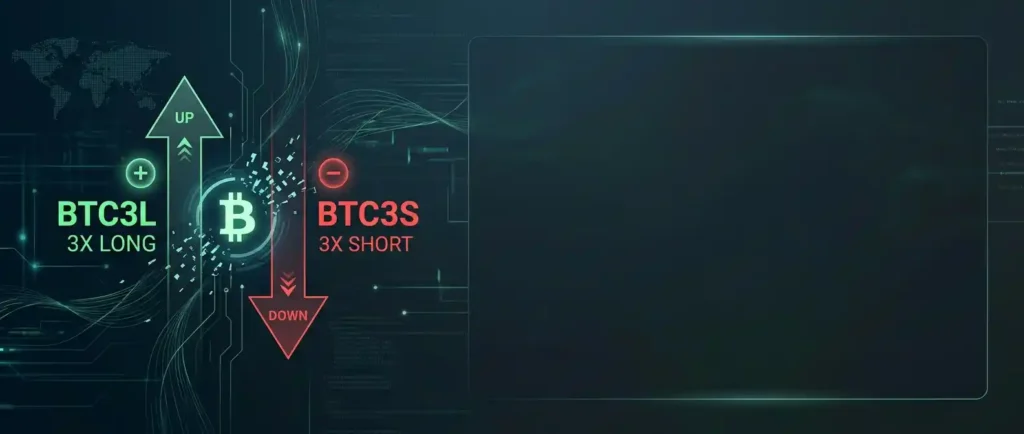
Crypto ETF Leveraged Tokens: BTC3L & BTC3S Trading Guide
Leveraged tokens are derivative trading instruments that track the daily percentage movement of an underlying cryptocurrency, multiplying the returns by a fixed or variable leverage factor (such as 3x). They allow traders to gain leveraged exposure to assets like Bitcoin or Ethereum without the requirement of margin collateral or the risk of forced liquidation.
Before executing a trade, you must understand that these tokens are designed exclusively for short-term trending markets. Holding them long-term in sideways markets mathematically guarantees capital loss due to volatility decay.
As a fintech systems analyst with nearly two decades of institutional banking experience, I emphasize banking-grade risk transparency: you must understand the underlying mechanics before deploying capital. In this guide, I demonstrate exactly how these tokens function, using the Gate.io exchange as a practical example.
Watch the full visual demonstration below before proceeding to the technical breakdown:
Time Stamp
0:00 Introduction to Leverage Tokens and Crypto ETFs
0:13 How to Navigate the Gate.io ETF Trading Interface
0:43 What is an ETF? Traditional vs Leveraged Tokens
1:18 Why Leveraged Tokens are Not Real Bitcoin or Ethereum
2:08 Explaining the Price Difference: Unit Value vs Asset Price
2:34 House vs Contract: The Derivative Trading Analogy
3:08 How 3x Long (BTC3L) and 3x Short (BTC3S) Amplify Gains
4:01 Why Every Exchange Has Different Leveraged Token Versions
4:31 The Key Rule: Tracking Percentage Movement Over Price
4:54 Understanding Rebalancing and Volatility Decay in Crypto
5:19 Real Assets vs Trading Tools: Final Summary
What Are Crypto ETF Leveraged Tokens?
A crypto ETF leveraged token is a fund managed by a cryptocurrency exchange that trades perpetual futures contracts on your behalf. When you buy a token like BTC3L, you are buying shares in a fund that holds a 3x leveraged long position on Bitcoin.
In traditional finance, an Exchange Traded Fund (ETF) usually holds a basket of spot assets. In crypto, these specific “ETF tokens” do not hold real Bitcoin or Ethereum. They hold derivative contracts designed to track the daily percentage price movement of the underlying asset.
Because the exchange manages the underlying margin positions, you simply buy and sell the leveraged token on the spot market just like you would a regular cryptocurrency.
The House vs. Contract Analogy: How BTC3L and BTC3S Work
To understand leveraged tokens, you must separate the real asset from the trading tool.
Think of real Bitcoin as a physical house. A leveraged token is a contract speculating purely on the percentage change in that house’s value.
- The Underlying Asset: The real Bitcoin determines the baseline price movement.
- The Trading Tool: The token (BTC3L or BTC3S) is a derivative built upon that movement.
If real Bitcoin increases in value by 5%:
- BTC3L (Bitcoin 3x Long): Increases by approximately 15% because it multiplies upward movement by three. You buy this when you expect the market to trend up.
- BTC3S (Bitcoin 3x Short): Decreases by approximately 15%. However, if real Bitcoin falls by 5%, BTC3S will increase by 15%. You buy this when you expect the market to crash.
You are trading the percentage movement, not the fundamental asset. The nominal price of the leveraged token (e.g., $0.05 per BTC3S) has zero correlation to the actual $60,000 price of Bitcoin.
Leveraged Tokens vs. Spot vs. Margin
Different market environments require different financial infrastructure. Here is exactly how leveraged tokens compare to traditional alternatives.
| Feature | Spot Trading | Margin / Futures | Leveraged Tokens |
| Asset Ownership | You own the actual coin. | You own a derivative contract. | You own shares in a derivative fund. |
| Liquidation Risk | None | High (Requires margin monitoring) | None (Auto-rebalanced by exchange) |
| Leverage | 1x | Up to 100x+ | Typically 2x, 3x, or 5x |
| Primary Fee | Maker/Taker trade fee | Hourly/8-hour funding rates | Daily Management Fee (~0.03% to 0.1%) |
| Market Condition | Long-term holding | Active precision trading | Short-term trending markets only |
The Hidden Mechanics: Rebalancing and Volatility Decay
The most critical failure point for retail traders using leveraged tokens is failing to understand the dual engines that power them: rebalancing and volatility decay.
What is Rebalancing?
Rebalancing is the automated background process where the exchange buys or sells underlying contracts to maintain the target leverage (e.g., exactly 3x). If a token falls out of its leverage range due to sudden price swings, the system recalibrates the fund.
What is Volatility Decay?
Volatility decay is the silent loss of capital experienced when a leveraged token is held in a sideways, oscillating market. Because the fund must constantly rebalance its positions to maintain leverage, “whipsaw” price action forces the fund to repeatedly buy high and sell low internally. Over a period of weeks in a sideways market, the Net Asset Value (NAV) of the token will bleed toward zero, even if the underlying Bitcoin price ends up exactly where it started.
How to Trade Leveraged Tokens (Gate.io Execution)
Navigating to the correct interface is the first step to executing a leveraged trade. Based on the smartphone demonstration in the video, here is the exact procedural workflow:
- Open the Application: Launch your exchange app (e.g., Gate.io).
- Navigate to Trade: Tap the primary “Trade” icon on the bottom navigation bar.
- Locate the ETF Sector: Swipe the top menu categories until you see the “ETF” tab.
- Select the Asset: Tap “ETF” to access the dedicated Leveraged Token spot market.
- Verify the Ticker: Ensure you are selecting the correct directional bias (e.g., “L” for Long if you are bullish, “S” for Short if you are bearish).
- Execute the Trade: Buy or sell the token exactly as you would execute a standard spot market limit or market order.
Note: Every exchange creates its own proprietary version of these tokens. A BTC3L token on Gate.io operates independently of a BTC3L token on Bybit or Pionex, even though they track the same underlying asset. Their rebalancing rules and management fees will differ.
The ASK JOFA Leveraged Trading Framework
If you choose to deploy capital into leveraged tokens, you must strictly adhere to structural risk management.
- The Trend-Only Rule: Only purchase leveraged tokens when the market has established a clear, aggressive directional trend (either upward or downward).
- The 48-Hour Rule: Treat these tokens as tactical, short-term instruments. They are not designed for Dollar-Cost Averaging (DCA) or long-term portfolio holding.
- The Insurance Hedge: You can use a small allocation of a “Short” token (like ETH3S) as temporary portfolio insurance if you hold a large spot position and anticipate a sudden, brief market correction.
Frequently Asked Questions
Can leveraged tokens be liquidated?
No. Unlike traditional margin or perpetual futures contracts, leveraged tokens do not require collateral margin from the user. The exchange’s algorithm dynamically rebalances the underlying positions to prevent the fund from reaching a liquidation point.
Why is the price of BTC3L so low compared to Bitcoin?
The price of the token is simply the Net Asset Value (NAV) of a single share in the exchange’s leveraged fund. It does not reflect the spot price of real Bitcoin; it only reflects the compounded percentage movements of the fund since its inception.
Are leveraged tokens the same across all exchanges?
No. Exchanges build their own proprietary algorithms for rebalancing. A 3x token on Gate.io may rebalance at different trigger points than a 3x token on Binance or Pionex. Always read the specific exchange’s documentation regarding their daily management fees and rebalancing thresholds.
What happens if the token price drops too low?
If a leveraged token bleeds too much value due to volatility decay, the exchange will execute a “reverse split” (e.g., a 1-for-50 split). This mathematically merges your shares to raise the individual token price back to a readable level, though the total dollar value of your position remains unchanged.
Build Your Digital Business with ASK JOFA
Understanding market infrastructure is only one component of navigating the digital economy. If you are struggling to build sustainable, smartphone-first cash flow, trading derivatives is not the starting point.
You need an audience, an understandable digital product, and an automated system to connect them. The ASK JOFA Search-to-Trust Acquisition Model helps creators and professionals package their existing knowledge into digital products using platforms like Selar, and drive targeted traffic using YouTube and SEO.
Explore the ASK JOFA YouTube Channel for foundational guides on setting up your digital infrastructure, understanding fintech payment rails, and monetizing your expertise across the global market.

John Ajiboye
Founder, ASK JOFA Digital · Creator of ASK JOFA Fintech · Architect of LAAS™
John Ajiboye is a digital marketing strategist, former institutional banker with 19+ years of experience, and founder of ASK JOFA Digital. Holding an M.Sc. in Computer Science, he combines deep financial discipline, technical architecture, and video marketing to build predictable lead-acquisition engines.
John is the creator of ASK JOFA, a leading fintech education platform and YouTube channel with over 31,000 subscribers. His channel provides step-by-step tutorials on digital finance, payment gateways, hardware wallets, and crypto platforms. He has executed successful content and acquisition campaigns for international brands including AirTM, Bybit, Gate.io, OneKey, ApexPay, PST, and Spend.Net.
Building on his success with organic search and video marketing, John developed LAAS™ (Lead Authority & Acquisition System)—a framework designed to help SMEs, consultants, and professionals build multi-channel visibility across YouTube, search engines, AI answer engines (AEO/GEO), and LinkedIn.
Through ASK JOFA Digital, John transforms expertise into automated media assets that attract high-intent leads and build lasting market trust—without relying on short-lived ad spend or social media virality. His systems are engineered to produce clear, actionable outcomes: helping professionals Get Hired™, consultants Get Clients™, and SMEs Get Customers™.